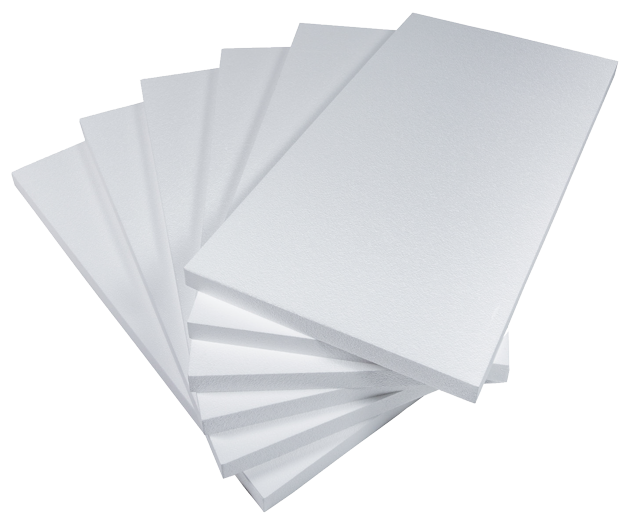
EPS16 2in x 4ft x 8ft Rigid Sheet Foam
Why Choose SuperForm EPS+
EPS+ vs. XPS Comparison
| EPS+ | XPS |
|---|---|
Cell Structure Manufactured from expanded polystyrene resin using a pentane blowing agent. This creates an air-filled, closed cell foam. | Cell Structure Manufactured using polystyrene, blowing agents, and dyes. This creates a closed cell foam that often contains hydrofluorocarbons (HFCs). |
R-Value Stability Provides a stable R-value that does not deteriorate over time. | R-Value Stability Less stable and the R-value deteriorates as gasses escape its cells. |
Long Term R Value: LTTR does not apply to EPS+, because it is not manufactured with the intent to retain blowing agent and due to its closed cell nature, there is no reduction in R value over time. | Long Term R Value: XPS uses a blowing agent when manufactured, thus it leaks over time reducing the R-value by 10% in 5 years, resulting in a R-value of 4.5, which is just below the R-value of EPS+. |
Compressive Strength Available in 10, 16, 20, 25, 30,40, and 60 psi. | Compressive Strength Available in 15, 25, 30, 40, 60, and 100 psi. |
Cost Impressive cost per R-value and compressive strength. As a result, EPS+ is a dependable, cost-efficient insulation solution. | Cost A much higher cost per R-value than EPS+. Additionally, its R-value is less stable and deteriorates over time. |
Water Absorption EPS+ absorbs more water initially but retains less water long term. Designed to quickly release moisture. This enables it to dry quickly and maintain its R-value over time. 15 years study shows 5% water absorption, 94% R-value retention. | Water Absorption XPS absorbs less water initially, but retains more water long term. Often traps moisture due to its low drying potential. Its inability to release moisture causes its R-value to deteriorate over time. 15 Year study shows 19% water absorption, 52% R-value retention. |
Water Resistance Closed cell polystyrene insulation that is resistant to moisture gain, proven to resist moisture in both short (24 hour) and long-term tests. | Water Resistance Closed cell polystyrene insulation that is resistant to moisture gain. However, its ability to resist moisture has only been proven in short-term (24 hour) tests. |
Vapor Permenance Ranges from 2.5 – 5.0 ng/Pa·s·m2 per inch thick. It is more breathable and dry’s better in wet climates. | Vapor Permenance Typically 1.5 ng/Pa·s·m2 per inch thick. Is not breathable and has high potential of trapping moisture in your wall due to its low drying capability. |
Environmental Impact Low impact on the environment. Its manufacturing process uses a pentane blowing agent instead of the hydrofluorocarbons (HFCs) blowing agents typically used to produce XPS. EPS+ has the lowest carbon footprint of all rigid insulation, up to 57 times lower. | Environmental Impact High impact on the environment. Its use of hydrofluorocarbons (HFCs) as a blowing agent cause a very high global warming potential (GWP). It also uses harmful color dyes not found in EPS+. Results in a carbon footprint of up to 33-57 times higher then EPS+. |
Dimensional Availability Options to suit every application - standard sizes or custom cuts to suit your needs. | Dimensional Availability Limited thickness and size options. |
Choose SuperForm's EPS Insulation Solution
SuperForm EPS+ Insulation is the smart choice for building a sustainable, energy-efficient future. It offers superior insulation performance, cost-effectiveness, and environmental benefits. Choose EPS+ for your next building project and experience the difference.